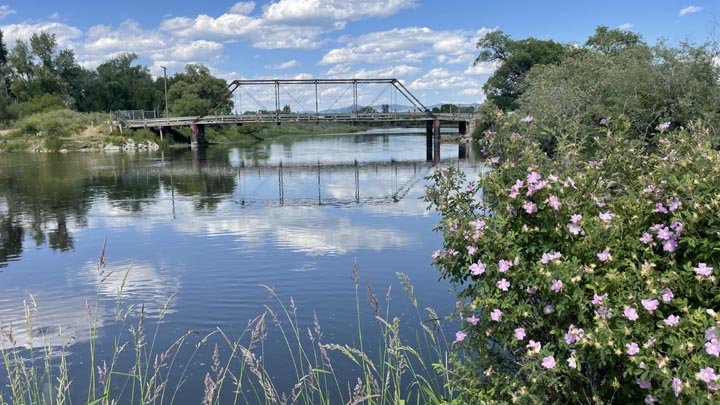
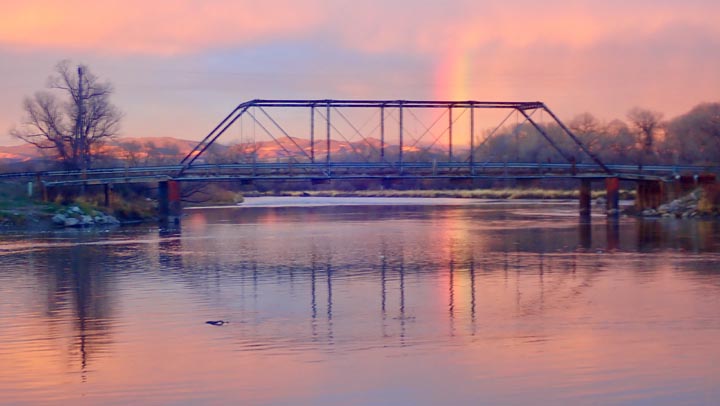
I've taken many "last" pictures of Old Town Bridge since it was condemned in 2022 and slated for replacement. Built in 1894, the bridge is a pin-connected Pratt truss design adapted from railroad use to handle horse-drawn wagons. Originally constructed within the town of Three Forks, the bridge has stood witness to 130 years of history while the town itself migrated a mile south and re-incorporated in 1908, leaving behind the old townsite and, with it, "Old Town Bridge."
More properly known as Old Town Bridge East to distinguish it from Old Town Bridge West, the east bridge spans the main channel of the Jefferson River. Although I had been under and over the bridge many times before, my relationship with Old Town Bridge grew deeper roots in 2014 when our Jefferson River Chapter of the Lewis and Clark Trail Alliance purchased the 4.4-acre parcel immediately southeast of the bridge as a walk-in fishing access site and public campsite for river paddlers.
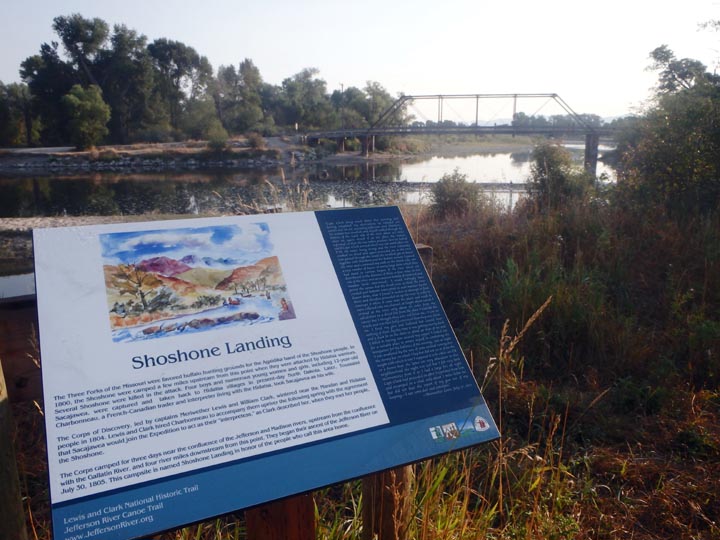
Chapter members voted to name the site Shoshone Landing in honor of Sacagawea and her people, who seasonally inhabited the area. Twelve-year-old Sacagawea, a member of the Lemhi Shoshone, was captured by Hidatsa warriors in the Three Forks area around 1800 and taken to the Knife River Valley of present-day North Dakota, where she was later married to French-Canadian trapper Toussaint Charbonneau. The couple joined the Lewis and Clark Expedition for the 1805-1806 portion of the journey to the Pacific Ocean and back, with Sacagawea later recognized for her many contributions to the successful completion of the expedition.
Jefferson River Chapter member Warren Swager commissioned an interpretive sign about Lewis and Clark and Sacagawea, which was installed overlooking the river and facing the iconic steel truss bridge. Chapter members have hosted many potluck picnics, work parties, and campouts on the property. We fixed fences, planted trees, and installed metal fire rings on site. The historic bridge, and the daring young people who jumped off of it, provided a consistent backdrop for every summer visit.
I've paddled the Jefferson River many times-often with chapter members, sometimes with friends, and occasionally as a guide with students of Green University. I've enjoyed many memorable stays at Shoshone Landing, numerous cooling swims in the river, and quiet hours spent on the riverbank gazing at the water and the bridge.
With permission from our Board of Directors, I brought ten Green University LLC Immersion Students to Shoshone Landing in the fall of 2020 to carve a fallen cottonwood tree into a dugout canoe.
Most cottonwoods along the Jefferson River are either narrowleaf or black cottonwoods, neither of which grow large enough for dugout canoes. The much larger plains cottonwood, also known as the eastern cottonwood, is mostly found farther downstream on the Missouri, but several giants tower over Shoshone Landing. My students and I camped there for two weeks while we roughed out the basic shape of the canoe and ultimately trailered it back to our campus near Whitehall. Naturally, several of my students took the plunge from Old Town Bridge.
I learned the craft of canoe building two years earlier from Churchill Clark, the great-great-great-great-grandson of Captain William Clark. Together we carved a 10,000-pound Douglas fir log into a twenty-foot-long wooden canoe that was still very, very heavy. I paddled the canoe 2,300 miles downriver to St. Louis, as told in the book Five Months on the Missouri River: Paddling a Dugout Canoe.
Carving a dugout canoe was supposed to be a once-in-a-lifetime experience, so I was surprised to come home to that freshly fallen cottonwood at Shoshone Landing with twenty feet of perfectly straight trunk, just begging to be made into a canoe. We counted 175 rings, indicating the tree sprouted forty years after Lewis and Clark passed through, but nearly fifty years before Old Town Bridge was constructed.
We worked on the dugout canoe on sunny days throughout the winter and launched it down the Jefferson River the following summer as part of a clean-up effort to dismantle a homemade boat that had wrecked downstream of Drouillard Fishing Access Site.
The boat, welded together from empty-but-not-clean barrels of hazardous chemicals and fitted with a motor, batteries, and speakers, had become known as the "Jefferson River Contraption" on YouTube. Jefferson River Chapter members paddled a flotilla of canoes down the river equipped with battery-powered drills, reciprocating saws, grinders, and assorted hammers, prybars, and other hand tools to dismantle the contraption. We hauled the scrap metal by canoe to Shoshone Landing, then transferred it to a truck for recycling.
Through it all, Old Town Bridge has been backdrop and witness to memories made on the Jefferson River.
Time marches ever forward, from Sacagawea and the Lewis and Clark Expedition to the short-lived establishment of Old Town Three Forks and a cottonwood that grew into a giant and ultimately became a canoe. Historic Old Town Bridge more than served its purpose over the past 130 years and probably long outlived the engineer's expectations.
One by one, the historic steel truss bridges of the Jefferson River have been replaced with modern concrete beam bridges. Now it is the end of the road for Old Town Bridge. Change is inevitable, and the improvements will provide greater functionality and safety for a new era. But in building a bridge to the future, we lose an iconic piece of our history. Old Town Bridge will be fondly remembered by those who knew her best.